Open Books Redesign
Improving Navigation and Information Architecture for a Nonprofit
ROLE
UX Designer
TIMELINE
Winter 2026
10-week academic project
SKILLS
User Research, Information Architecture, Content Strategy
The Problem
A confusing site that buried key information
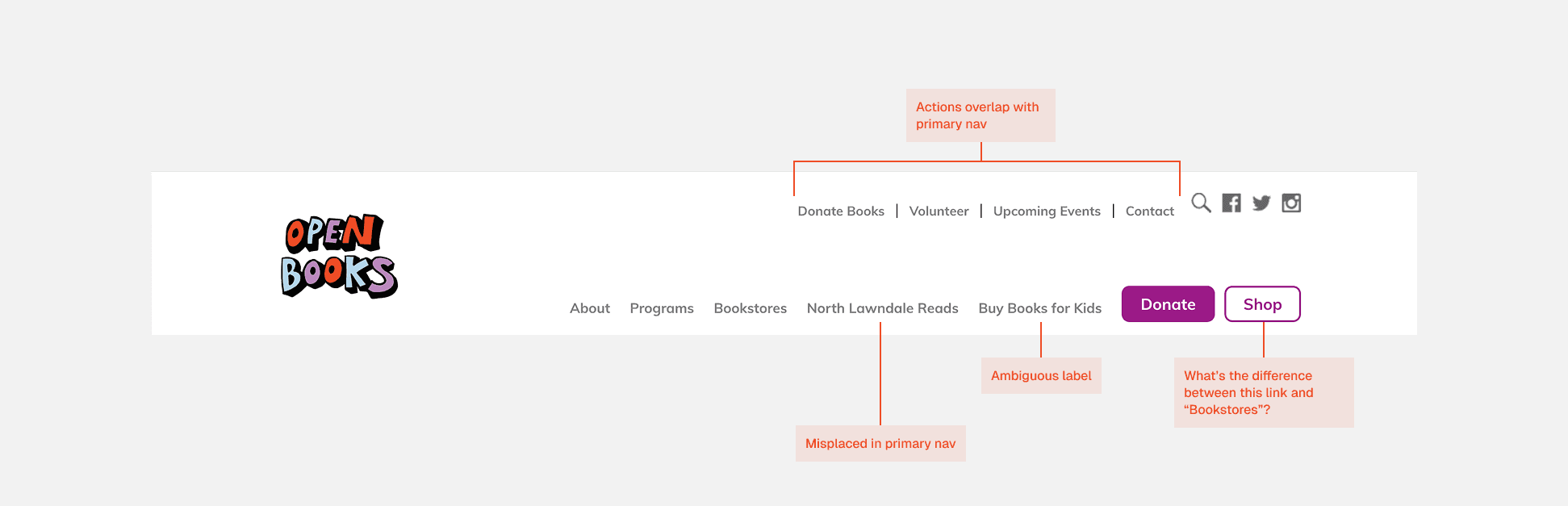
Open Books is a Chicago-based nonprofit dedicated to improving literacy through community programs. Their mission is clear, but the structure of the site is confusing. This makes it difficult for users to complete tasks.
Process
Content inventory → card sort → tree test → sitemap
We started with a full content inventory to understand what was actually on the site before proposing any changes. That gave us the raw material for the card sort. In our card sorts, we asked participants to group page names into existing categories.
A few things stood out immediately:
Cards needed clearer names. "Access to Books" (actually a grants page) confused nearly everyone. Renaming it "Grant Information" fixed the problem in the next round.
The "Support" category was ambiguous. Renaming it "Support Us" made it clear that it is a user action, not information about how the organization supports the community.
Events should be a standalone tab. Participants did not agree on where it belonged under other categories.
We validated the proposed sitemap with a tree test. We gave participants three tasks and asked them to navigate the tree to complete them. Finding location hours and volunteer information both performed strongly. We used the results to confirm the structure before moving into wireframes.
fiNAL dESIGN
A seven-category sitemap built around key user actions
The redesigned navigation uses task-based labels at the top level and topical organization one level down.
Wireframes focused on the two highest-stakes flows: donation and location-finding. The heuristic analysis showed the existing donation form scored lowest on error prevention and recovery, so we prioritized inline validation and clearly marked optional steps.
rEFLECTION
What I took away
This project taught me that improving IA is an iterative process. When conducting the card sorts and tree tests, we treated each round as a chance to fix the round before it.
With more time, I would run usability tests on the wireframes to close the loop between the research and the final interface.